* Approved by Archax LTD on 08.11.2024
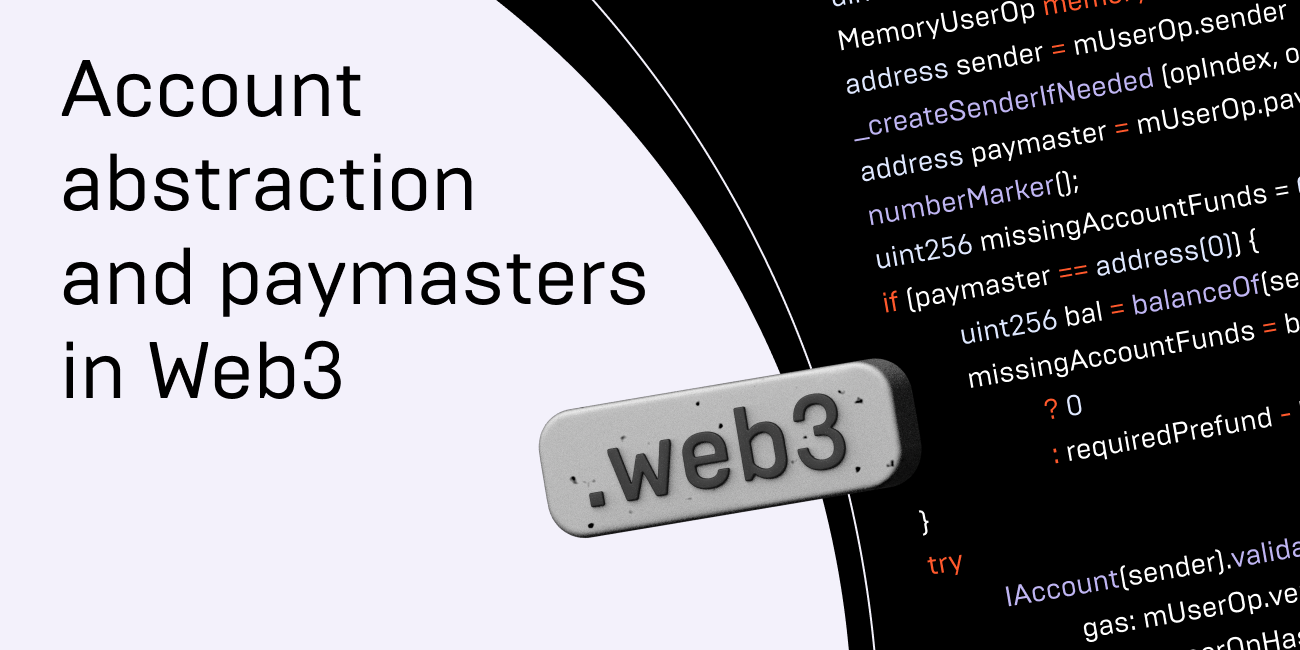
The Web3 environment is developing into a platform capable of hosting various applications and services.
Account Abstraction
Account abstraction in web3 is a relatively new concept that foresees the creation of a self-custodial wallet built as a smart contract. This concept was made possible thanks to the application of the ERC-4337 standard on Ethereum, which gives users ownership of the smart contracts without having to go through an EOA signature. In essence, such a smart contract can cope with such operations as multi-factor authentication, custom rule inclusion, and recurring payments, all based on policies that the user themselves can define.
The account abstraction concept can pass through paymasters, which abide by sponsorship rules. This lets users bypass gas fee payments by offsetting them to a third-party, such as a DeFi service, an application, or any other dApp willing to support account abstraction. A paymaster is therefore an entity that can sponsor gas fees for transactions on Ethereum-based networks. Should a paymaster agree to process the transaction of a user, it will have to pay the gas fee as well. These processes are coordinated through an EntryPoint contract that handles all verifications entailed in ERC-4337 operations. The paymaster stakes ETH at the EntryPoint.
Basically put, account abstraction allows users to pay their gas fees in a multitude of ways, using stablecoins or ERC-20 tokens, or even fiat while retaining complete custody of their wallet account. The upside of using ERC-4337 is that it lets special proxy EOAs, known as Bundlers, combine multiple user transactions in a mempool. The paymasters, as optional smart contracts that can sponsor transaction fees for users, apply a certain fee logic during the transaction execution phase, thus streamlining the payment flow for users.
More on Paymasters
A paymaster is a key player or smart contract mechanism developed specifically for web3 to streamline gas fees on behalf of users or other contracts deployed by services and applications. The instrument is designed to process payment workflow of users in their interaction with dApps and services by making injections of liquidity more comprehensive.
Both paymasters and on-ramps serve in unison to create a favorable financial environment in web3, with paymasters facilitating transactions by handling gas fees, and on-ramps allowing the exchange of fiat into cryptocurrencies. By combining these two elements into a single whole, users will be able to conduct transactions in web3 using any means they deem convenient, thus funding the digital economy and granting access to web3 services, advancing innovation.
The standard for paymasters at present in web3 is the EIP-4337, which is a smart contract that can take on the responsibility of paying gas fees in the stead of applications. The logic behind the smart contract is that it can alleviate the interaction of both users and applications with financial gatekeepers and the blockchain, freeing up time and vastly shortening the transaction process. By this, paymasters further help users’ requirements for blockchain knowledge and save them the trouble of having to pay gas fees by themselves.
Use Cases Highlighting Paymaster Impact
Apart from facilitating user interactions with web3, paymasters also have a number of unique use cases that grant them application in several finance-intensive areas.
DeFi
The decentralized finance sector is heavily reliant on on-ramps, like exchanges and exchangers, for accepting fiat as a form of initial funding. Since the liquidity is transferred to wallets, users and DeFi platforms alike can leverage the services of paymasters to streamline transaction execution without concerns for gas fees.
Wallets will be the most affected in DeFi by the introduction of paymasters, as the service will allow users to transfer any kind of asset across the Ethereum network without having to incur gas fees as a separate step.
NFT Sector
On-ramps are just as essential in the NFT marketplace sector, where they allow users to purchase cryptocurrencies for fiat for subsequent investment in collections. Should a service or application opt to do away with on-ramps in its framework, the paymaster can flawlessly take its place and perform the same functions. The inclusion of paymasters in the chain would accelerate NFT mint processes and facilitate transfers of assets without upfront gas fees.
Gaming
The gaming sector and its metaverse by-sector are important segments of the blockchain industry with immense financial turnovers. Paymasters could reduce friction in the gaming economy, freeing gamers from having to consider gas fees in their in-game transactioning, thus accelerating gameplay experiences and increasing payment volumes.
User Level
On the user level, microtransactioning is one of the most common use cases for cryptocurrencies, with individuals transferring assets on a peer-to-peer basis between wallets. Paymasters can provide a near instant transacting experience multiple times over without the prohibitive gas fee step involved.
Services Relying on Account Abstraction
As the concept of account abstraction and ERC-4337 standards are still at the development stage, there are not that many services actively using them. However, wallets are. Among the most prominent examples one can single out the following:
Avocado
A wallet with account and network abstraction at heart, Avocado is tailored for use in the DeFi sector, providing users with deterministic smart contracts, multi-network transaction processing, and a host of features that make it user-centric.
Ambire Wallet
Launched in 2021, Ambire Wallet has set itself in a league of its own in terms of account abstraction and offers at start a host of important functions, such as batch transactions, multi-signature options, and fee payments in stablecoins.
Among the other wallets one can mention that support account abstraction are Sequence and Safe, both of which provide virtually the same lineup of services as the aforementioned trio.
As for projects focusing on account abstraction, it is possible to note the following:
Pimlico – an ERC-4337 project aimed at creating an infrastructure layer for dApps and wallets for advancing Ethereum’s transition to smart contract wallets.
Permissive – a web3 SDK provider for ERC-4337 use. The project relies on an authorization framework, which is facilitated by account abstraction via a native wallet.
Benefits of Using Paymasters
The biggest upside of resorting to paymasters is on the user side, as they reduce technical barriers for web3 entry and thus facilitate interaction with blockchain-based applications while lowering the degree of financial unpredictability.
Paymasters allow for efficient integration of gas sponsorship through a single instance without having to install multiple gateways. By enabling a single setup, paymasters vastly streamline business and user-lever transactions.
Paymasters also aims to simplify fallback handling by allowing businesses to grant their users the ability to pay in any convenient coin or token.
There is also significant potential for innovation in terms of paymasters, as their use gives developers the freedom to experiment with more complex functionalities without having to fear for costs incurred by users. Among the functionalities that can be explored as added value modules in applications are cross-chain protocols, streamlined gamification features, or even native exchanges. The improved predictability of operational costs for businesses further enhances business resource planning and thus can have a positive impact on company traction, expanding the web3 environment.
Challenges and Considerations
As Web3 is still in the development stage, the use of paymasters is mostly experimental. This means that their implementation requires not only a careful approach, but also raises questions regarding prevention of abuse and fraud. The complexity of integrating paymasters into on-ramps is also to be addressed, as exchanges may be unprepared or unwilling to interact with unproven services. Questions of security, sustainability and the implementation of transparency mechanisms that govern fee handling are all still unresolved, hampering the introduction of paymasters on a large scale.
Among the other issues to be resolved in the introduction of paymasters, one can single out the following:
- Business-set conditions for commitments to gas fee sponsorship via paymasters. The users will essentially be given a choice to either submit to unfavorable service conditions, or face the inconvenience of handling gas fees by themselves.
- Unprofitability of gas fee handling for businesses on a regular basis. This would lead to users having to enjoy paymaster benefits under certain conditions, but having to handle gas fees most of the time in their operations.
Future Prospects and Conclusion
The partnership between paymasters and on-ramps is vital for further facilitating the onboarding of new users into web3 by aiming to simplify the complicated and multi-step transaction process. Once account abstraction supporting wallets are added to the mix, their combination with on-ramps will make it possible for users to make payments using any kind of means they find convenient. This would improve the usability of web3 as a whole by streamlining the user experience via wallets as the single access points owned by users, and foster widespread adoption, while making business operations in the decentralized space more attractive for companies,
Mercuryo encourages continued innovation and collaboration within the web3 community to refine and expand the use of paymasters. Their ongoing development, and the addressing of security issues, would contribute to driving forward the adoption of blockchain technology by making it more accessible and user-centric for new audiences across markets.